Activation Capacity Planning
How Many Activation Stations Do You Need for Your Event?
Guest count matters. But the number of people attending your event isn't the number that determines how many activation stations you need.
Plan My ActivationOne of the most important questions when planning a live personalization experience is also one of the most overlooked:
How many activation stations do we actually need?
The answer depends on more than guest count.
You need to consider how many guests will participate, how long the activation is open, how quickly each experience can realistically be completed, and whether guests arrive steadily or all at once.
At The Sweet Printer, we plan activations around real-world throughput — not simply the maximum speed printed on a machine specification sheet.
Expected Participants ÷ Event Hours ÷ Realistic Hourly Throughput Per Station = Stations Required
Add appropriate operational buffer when timing, guest flow or participation is unpredictable.
Machine Speed Is Not the Same as Event Throughput
A machine may technically produce an item in seconds. That does not mean a guest experience takes seconds.
A live activation often includes:
- Guest approaches the activation
- Guest decides what they want
- Guest selects or uploads a photo
- Guest enters personalization
- Staff reviews the submission
- The item is produced
- Finishing or packaging is completed
- The personalized item is handed to the guest
That entire process determines your real throughput.
"Always calculate capacity using real-world event throughput — not the theoretical maximum speed of the machine."
— The Sweet Printer
Why "It Only Takes 30 Seconds" Can Still Create a Two-Hour Line
One of the biggest mistakes in live event planning is calculating capacity using production time alone.
Imagine an item takes only 30 seconds to produce. That sounds like 120 guests per hour.
But if each guest spends another minute choosing a design, finding a photo, entering their name, asking a question or deciding between options, the actual throughput can be dramatically lower. Guest behavior matters just as much as machine speed.
At high-volume events, reducing the amount of decision-making required at the production station can have an enormous impact on capacity. QR-code uploads, preselected product choices, clearly displayed examples and streamlined personalization workflows can all increase throughput.
How to Calculate the Number of Activation Stations You Need
Determine your realistic participation rate.
Not every attendee will participate. A 1,000-person conference does not automatically mean 1,000 personalized items. Estimate how many guests are realistically expected to engage.
Determine how many hours the activation will actually operate.
A three-day conference may only have six hours of meaningful exhibit-floor traffic. A reception may have 500 attendees but only a two-hour activation window.
Determine realistic hourly throughput per station.
Use actual live-event production numbers whenever possible. Do not calculate based solely on machine specifications.
Account for peak demand.
People rarely arrive perfectly evenly. Conference breaks, session releases, cocktail receptions and meal transitions can send hundreds of people into an activation area simultaneously.
Add operational buffer.
If the math says you need exactly three stations, three stations may leave no room for delays, guest questions, difficult personalization requests or equipment interruptions. For mission-critical high-volume experiences, capacity planning should include a reasonable buffer.
Example: How Many Stations Do I Need for 500 Guests?
The number of stations required for a 500-person event depends on participation rate, event length and production speed.
Example:
500 attendees
60% expected participation
= 300 participants
300 participants
÷ 3 event hours
= 100 guests per hour
If one activation station can realistically accommodate 50 guests per hour:
100 guests per hour
÷ 50 guests per station
= 2 activation stations
Operationally, a planner may choose additional capacity if guests are expected to arrive in large waves.
Choosing an Activation Based on Guest Volume
| Activation | Relative Throughput | Personalization Level | Best Use |
|---|---|---|---|
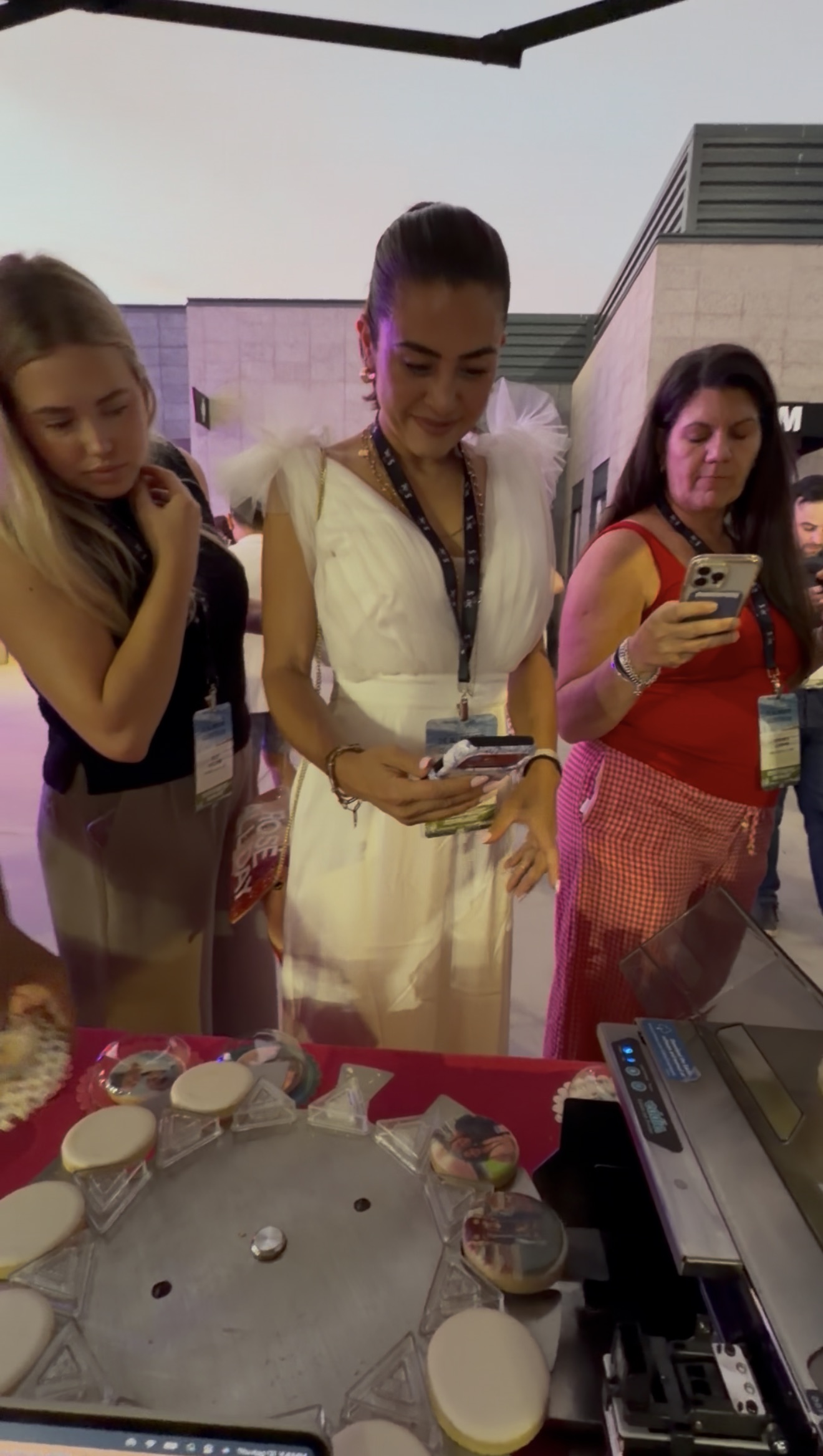
| Live Cookie Printing | Very High | Highly Personalized | Trade shows, conferences and high-volume events |
| Live Sugar Printing | Moderate | Highly Personalized | Experiential activations where watching the creation process is part of the attraction |
| Laser Engraving | Moderate | Highly Personalized | Premium keepsakes, executive gifts and durable branded items |
| Luggage Tag Personalization | Moderate | Highly Personalized | Travel programs, incentives and destination events |
| UV Printing | Moderate | Highly Personalized | Durable personalized gifts and unusual surfaces |
| Live Apparel Personalization | Moderate | Highly Personalized | Lifestyle, fashion and consumer activations |
Actual throughput varies depending on the product, personalization requested, workflow, equipment configuration, staffing and event conditions.
What Activation Works Best for 100 Guests?
For approximately 100 guests, planners can usually prioritize deeper personalization because throughput is less restrictive.
Smaller groups are ideal for premium experiences including laser engraving, luggage tags, sugar printing, highly customized keepsakes and other activations where each guest can spend more time participating in the creation process.
What Activation Works Best for 250 Guests?
For approximately 250 guests, both premium personalization and higher-throughput experiences can work well, depending on the event window.
A three- or four-hour event gives planners considerably more flexibility than a 90-minute reception. Multiple stations may be recommended when participation is expected to be high.
What Activation Works Best for 500 Guests?
For 500 guests, throughput should become a major part of the activation design.
High-speed experiences such as live cookie printing can accommodate larger audiences, while slower premium personalization experiences may require multiple stations. The goal is not simply to produce 500 items. The goal is to produce them without creating a frustrating guest experience.
How Do You Personalize Gifts for 1,000+ People?
Large-scale personalization usually requires a combination of faster technology, multiple production stations, streamlined guest input and careful queue planning.
For high-volume conferences and trade shows, production should be engineered around guest flow from the beginning. Strategies can include:
- Multiple production stations
- QR-code photo or personalization uploads
- Separate guest-input and production areas
- Preselected personalization options
- Dedicated pickup areas
- Queue management
- Additional staff
- Hybrid pre-production plus live personalization when appropriate
The faster the event, the fewer unnecessary decisions guests should have to make at the production station.
Can The Sweet Printer Scale for Any Number of Guests?
Yes. The Sweet Printer can scale our activations to accommodate virtually any number of guests — from 100 people at a private event to thousands of attendees at a convention, festival, arena or stadium.
We don't approach a 10,000-person event by trying to push everyone through one machine. We scale the experience.
That can mean adding:
- More printers or production equipment
- Multiple activation stations
- Additional trained operators
- Multiple activation locations throughout a venue
- Separate ordering and pickup areas
- QR-code photo and personalization submission
- Pre-production combined with live customization
- VIP and general-attendee activation tiers
If one station isn't enough, we add more. If one activation area can't handle the traffic, we distribute the experience. If tens of thousands of guests are expected, we design the production and fulfillment strategy around that audience from the beginning.
The size of the crowd doesn't determine whether personalization is possible. It determines how we scale it.
From an intimate 100-person reception to an entire stadium, The Sweet Printer can build the equipment, staffing and production footprint around the number of guests you need to accommodate.
Large Crowd? We Scale the Activation.
100 guests
We can design for 100.
1,000 guests
We increase capacity.
10,000 guests
We build a multi-station strategy.
A stadium
We scale again.
There isn't a fixed maximum guest count for a Sweet Printer activation. We scale the number of stations, equipment and staff to meet the needs of the event.
The Rush Is Usually the Problem — Not the Total Guest Count
A 1,000-person event spread across eight hours can sometimes be easier to manage than a 300-person reception lasting 90 minutes. Why? Because guests do not arrive evenly.
- •At trade shows, exhibit floors may suddenly fill when a keynote ends.
- •At conferences, hundreds of attendees may enter the activation area during the same scheduled break.
- •At evening receptions, nearly everyone can arrive within the same 20-minute window.
Experienced activation planning accounts for peak demand — not simply total attendance.
How The Sweet Printer Designs High-Volume Activations
The Sweet Printer specializes in live personalization experiences designed for real event environments. Our capabilities include live cookie printing, sugar printing, laser engraving, luggage tag personalization, UV printing, apparel personalization and other made-on-demand brand experiences.
We evaluate activations based on:
- Number of attendees
- Expected participation
- Activation hours
- Guest arrival patterns
- Personalization complexity
- Production speed
- Number of available stations
- Staffing
- Venue layout
- Desired guest experience
Sometimes the best solution is the most personalized activation. Sometimes it is the fastest. And sometimes it is a combination of several experiences designed for different levels of guest engagement.
Frequently Asked Questions About Event Activation Capacity
Not Sure How Many Stations Your Event Needs?
Tell us your guest count, event length, location and what you want guests to experience. We'll help determine the right activation, realistic throughput and number of stations required to make it work.