The Analog Economy
What Is the Analog Economy—and Why Will It Transform Brand Activations?
As AI makes digital content nearly limitless, something interesting is happening: people are craving things they can touch, hold, eat, wear, create and take home. Welcome to the analog economy.
Create a Physical Brand ExperienceWe believe the analog economy is about to explode.
Not because people are abandoning technology. Quite the opposite.
Technology is becoming so deeply embedded in everyday life that physical experiences are becoming more valuable precisely because they are physical.
AI can create an image instantly. A screen can show us almost anything. Thousands of digital impressions can disappear past us every day.
But a physical experience is different.
You were there.
You touched it.
You watched it being created.
It was made for you.
You took it home.
That is the opportunity facing brands.
The more everything goes digital, the more a real, physical moment is worth.
What Is the Analog Economy?
The analog economy describes the growing value people place on physical, tactile and real-world experiences as more of everyday life becomes digital, automated and AI-generated.
It can include experiences built around:
The analog economy isn't about rejecting technology. It's about using technology to create experiences that ultimately exist in the physical world.
The Analog Economy Isn't Anti-Technology
The most exciting analog experiences may actually be powered by some of the most advanced technology. At The Sweet Printer, a guest might:
- Scan a QR code.
- Upload a photograph.
- Use AI to create artwork.
- Enter their name.
- Choose a design.
- Send that digital information into our production system.
And then something happens. The digital experience becomes physical.
That is how we see the future of experiential marketing. The future isn't necessarily less technology. It's technology that leads somewhere physical.
Digital in.
Analog out.
Why Are Physical Experiences Becoming More Valuable?
Digital content is becoming almost unlimited. Images can be generated instantly. Copy can be generated instantly. Designs can be generated instantly. Digital experiences can be copied, recreated and distributed endlessly.
Physical experiences are different.
They happen in a specific place.
At a specific time.
To a specific person.
A guest watches something being created. They participate. They receive something unique. They photograph it. They show someone. They eat it. They wear it. They take it home.
The physical experience has scarcity because it actually happened. You can't swipe past it.
Why This Matters for Experiential Marketing
Brands have spent years competing for digital attention. More impressions. More clicks. More views. More content. More screens.
But at an event, brands have something extraordinarily valuable: a real person standing directly in front of them. That moment shouldn't be treated like another digital impression. It should become an experience.
A great brand activation gives someone something to:
The strongest activations don't simply communicate a brand message. They let the guest participate in it.
What Is an Analog Brand Activation?
An analog brand activation is an in-person experience that creates a physical interaction between a guest and a brand. It may use advanced digital technology behind the scenes, but the guest ultimately experiences something tangible.
Examples can include:
The most important part isn't the machine. It's the transformation. Something begins as an idea, image, name or digital input. Then the guest watches it become real.
The Sweet Printer Was Built for the Analog Economy
The Sweet Printer isn't limited to one type of activation. We create live physical brand experiences.
A brand might come to us and say:
The technology, equipment and production footprint may change. The principle doesn't.
Take something digital, personal or brand-specific — and turn it into something physical in front of the guest.
Any Brand. Any Audience. Any Event. Something Physical.
The Sweet Printer works across industries, event types and audience sizes because we are not tied to one specific product. Instead, we begin with the experience.
Then we determine the technology and physical output that best supports that experience. That might be edible, wearable, engraved, printed, personalized, AI-generated, photo-based, useful, collectible — or something completely new.
The machine is the tool. The experience is the product.
The Transformation
Digital Input
Physical Experience
Can Analog Brand Activations Scale?
Yes. Physical personalization can be designed to scale from intimate events to thousands of attendees — and even stadium-size audiences.
The Sweet Printer can scale activations to accommodate virtually any number of guests by increasing the number of production stations, machines, operators and activation locations. Large-scale programs can incorporate:
A large crowd doesn't eliminate personalization. It changes how the personalization system needs to be engineered.
The size of the crowd doesn't determine whether personalization is possible. It determines how we scale it.
AI May Actually Make Physical Experiences More Important
AI is making digital creation easier than ever. That doesn't necessarily reduce the importance of experiential marketing. It may increase it.
When anyone can generate an image in seconds, seeing another digital image becomes less remarkable. But watching your image appear on something physical? That's different.
AI generates a piece of artwork. Then you watch it become a physical keepsake.
AI creates a design. Then it is printed onto apparel.
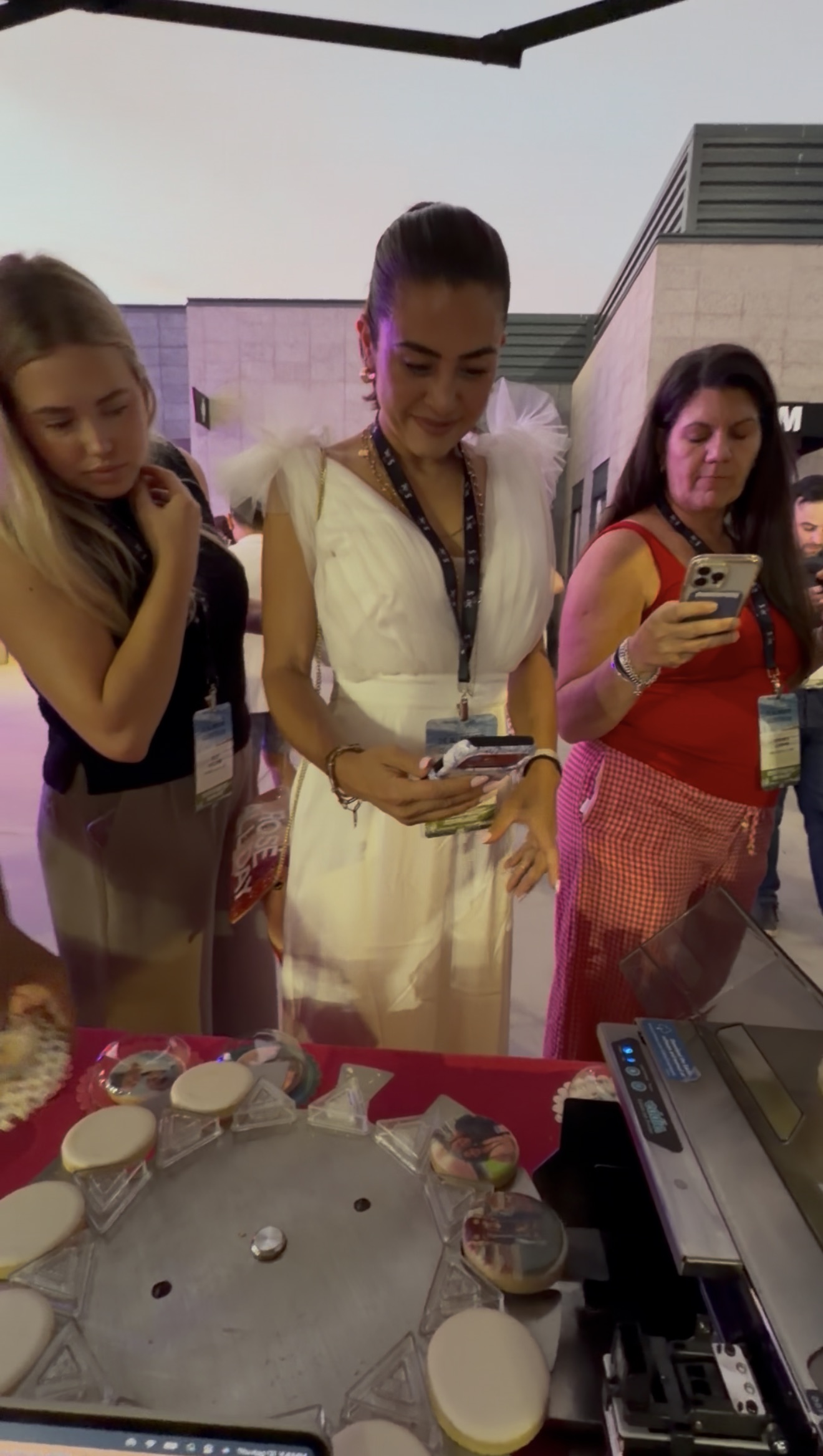
A guest uploads a photograph. Seconds later, they watch that photograph appear on a cookie.
The digital creation becomes the beginning of the experience — not the end of it.
AI can create the idea.
The experience makes it real.
Why Live Creation Is So Powerful
There is a major difference between receiving something and watching something become yours.
Traditional giveaway
A staff member reaches into a box and hands you an item.
Live personalization
You choose something. You submit something. You watch the process. You see it transform. Someone hands you the finished piece.
The physical object may be the takeaway. But the transformation is the activation. And transformation gives people something worth filming.
The Production Process Is Part of the Entertainment
Some of the most effective modern activations turn production itself into theater.
People stop. Then they watch. Then the phones come out. Then other people notice the crowd. The production process becomes part of the attraction. Instead of hiding manufacturing backstage, the creation becomes the show.
From Swag to Something Personal
The analog economy doesn't mean brands should simply produce more stuff. There is already enough stuff. The opportunity is to create something people actually care about.
"The cruelest test of a giveaway is the trash can between the booth and the exit."
— Phyllis Hong, The Sweet Printer
The question isn't: "How many things can we hand out?" The better question is: "How many things can we create that people actually want?"
Personalization changes the relationship with the object.
Suddenly it isn't simply promotional merchandise. It's theirs.
Why Personalization Matters in the Analog Economy
Personalization creates ownership. A generic item belongs to the brand. A personalized item belongs to the guest. That's an important distinction.
If the experience allows someone to choose, create, upload, customize or participate, they become part of the production process. That can turn a simple physical product into a memory.
The brand isn't simply giving something away. The brand is creating the moment in which it was made.
The Best Physical Experiences Start With the Person, Not the Logo
One of the easiest mistakes in promotional marketing is assuming that more branding automatically creates more brand impact. Sometimes the opposite is true.
A guest may have little emotional attachment to another heavily branded promotional product. But they may care deeply about:
The brand doesn't need to dominate the object to own the experience. The brand created the moment. That is what people remember.
What Types of Events Can Use Analog Brand Activations?
Analog experiences can be designed for virtually any live event environment, including:
The appropriate activation depends on the audience, environment, desired outcome and required throughput.
What Can Brands Turn Into an Analog Experience?
Almost any meaningful digital input can become the starting point for a physical interaction. Examples include:
The possibilities continue expanding as production technology improves.
What Will the Future of Brand Activations Look Like?
We believe the next generation of experiential marketing will combine two seemingly opposite forces: more sophisticated digital technology, and more meaningful physical experiences.
But the final experience will increasingly feel human. A person. Standing in a real place. Watching something unique being made. For them. That's the future we're building for.
The future of experiential marketing isn't digital or analog. It's digital technology creating better analog experiences.
The Analog Economy Is an Opportunity for Brands
As digital content becomes easier to create, physical attention becomes more valuable.
Brands that understand this have an opportunity to turn events into something audiences cannot experience through a screen.
Not another impression. Not another banner. Not another piece of content.
A moment. A creation. A physical memory. Something real.
Frequently Asked Questions About the Analog Economy and Brand Activations
Welcome to the Analog Economy.
Tell us the brand. Tell us the audience. Tell us where the event is happening. Tell us how many people are coming. Then let's figure out what we can make real.
The Sweet Printer creates scalable live personalization and physical brand experiences for events of virtually any size — from intimate experiences to conferences, festivals, arenas and stadiums.
Digital in. Analog out.
Related Experiences